
February 17, 2026 | by Le Due Querce editorial team
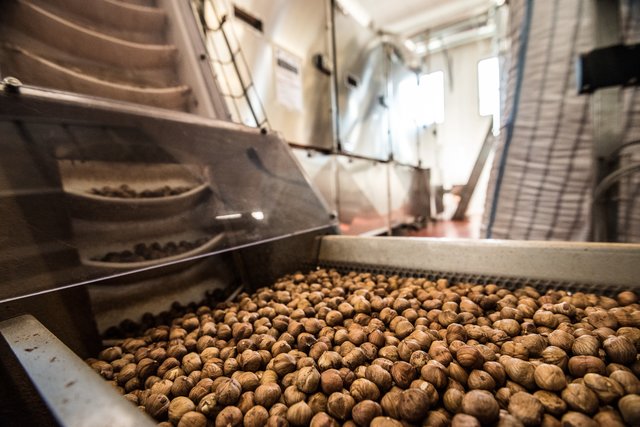
Roasting is the step that transforms hazelnuts from raw material to ingredient. But “roasting” is not a binary operation: it’s a process where temperature and time interact in a non-linear way, and where each choice produces precise and measurable effects on the final product.
Understanding what happens during roasting is useful not only for those who transform, but also for those who buy: because roasting reveals — or amplifies — what’s really in a batch.
What happens during roasting
Roasting is first and foremost a controlled moisture removal. The original goal was practical: reduce water content to extend shelf life and make transport safer. Over time, it has also become the way to develop the characteristic aromatic profile of roasted hazelnuts.
The main changes occur on three levels. The first is physical: the hazelnut loses moisture, becomes crunchier and the outer skin (the perisperm) detaches more easily. The second is chemical: heat activates the Maillard reaction between sugars and amino acids, producing hundreds of volatile compounds responsible for the roasted aroma. The third concerns the lipid component: fats, which constitute about 60% of the hazelnut, begin to oxidize more rapidly once the cellular structure is altered by heat.
These three levels do not proceed in parallel: they depend on temperature and time in different ways, and finding the balance point is exactly what distinguishes a good roasting from a mediocre one.
The role of temperature and time: what research says
CIRI Agroalimentare has systematically studied the effect of two temperatures (130°C and 160°C) and different exposure times on the profile of roasted hazelnuts, measuring phenolic compounds, tocopherols (vitamin E), lipid oxidation state and volatile profile.
The most interesting result is that low temperatures and short times do not automatically produce the best product. At 130°C with adequate times, a good balance is obtained between aromatic development and preservation of bioactive compounds. At 160°C, times must be shorter: extending exposure to high temperature accelerates lipid oxidation and degrades tocopherols, which are both antioxidants and nutritional quality markers.
The practical consequence is that there is no “right” temperature in absolute terms: there is an optimal time-temperature combination that varies according to the characteristics of the incoming batch, especially its moisture content. A moister hazelnut needs longer times or higher temperatures to reach the same degree of roasting as a drier hazelnut. This is why professional roasters calibrate the process batch by batch, they don’t apply fixed parameters.
In-shell or shelled roasting: concrete differences
Hazelnuts can be roasted with the shell or already shelled. The differences are not marginal.
In-shell roasting is slower and less uniform: the shell acts as a thermal barrier, slowing heat penetration. The advantage is that it protects the kernel during the process, reducing direct contact with oxygen. It’s the method used when you want to keep the hazelnut whole for specific uses (snacks, decoration, premium products).
Shelled roasting allows more precise temperature control on the kernel, more uniform browning and more predictable times. It’s the industrial standard for pasta, chopped nuts and ingredients. The loss of shell protection means that temperature management is more critical: a variation of 10-15°C in excess translates directly into a worse aromatic profile and an acceleration of post-roasting oxidation.
Shelf life after roasting: an underestimated aspect
Roasting extends shelf life compared to fresh hazelnuts just harvested, but significantly shortens shelf life compared to dried unroasted hazelnuts. It’s an important distinction that buyers don’t always consider.
The reason is structural: heat alters the cellular membranes that protect lipids from oxygen. A roasted hazelnut has more exposed fats. Oxidation that in a dried and well-preserved hazelnut takes months to become perceptible, in a roasted hazelnut at room temperature can become evident in weeks.
Professional roasters working with small volumes often roast only what’s needed for daily production, precisely to avoid stored roasted product degrading before use. For those who buy already roasted hazelnuts, the roasting date is therefore information as relevant as the harvest date.
What roasting reveals about a batch
Roasting doesn’t improve the starting hazelnuts: it reveals them. It’s a magnifying glass on the characteristics of the incoming batch, for better and for worse.
A batch with a good raw aromatic profile develops more intense and complex notes after roasting. A batch with anomalous raw odors, slight rancid notes or absorption of external odors will see these defects significantly amplified. What was barely perceptible raw often becomes evident and annoying after heat treatment.
This has a direct implication for those who buy hazelnuts intended for transformation: sensory evaluation raw is a necessary but not sufficient condition. A batch that passes the raw organoleptic control can still prove problematic after roasting if it contains defects at the limits of perception.
The most reliable practice, for those who transform, is to verify the batch also after roasting a sample, before committing to the entire batch.
To understand how to sensorially evaluate a batch of hazelnuts before roasting, read How to evaluate a batch of in-shell hazelnuts: sensory controls, defects and right questions.
To deepen how conservation affects quality before and after roasting, consult Conservation of in-shell hazelnuts: humidity, odors and risk signals.
For comparison with a similar approach applied to almonds, see Almonds, conscious consumption: stability, odors and roasting explain more than a thousand promises.