
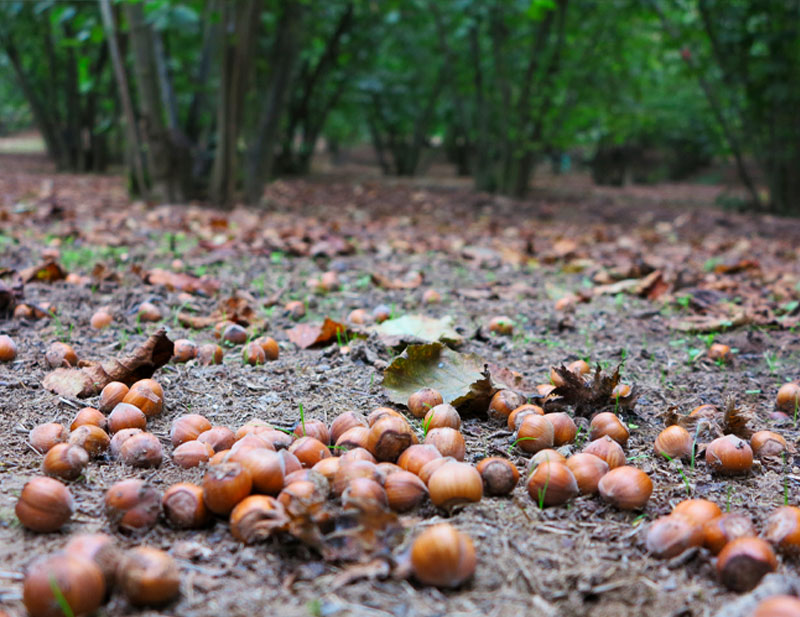
When we talk about hazelnut “seasonality,” many think of a calendar: before or after, new or old. In reality, it’s more useful to imagine it as a sequence of real changes, first in the fruit as it matures, then in the immediate phases after harvest. This is where perceived quality and availability are built, both for those buying a small bag and those purchasing a batch.
From field to post-harvest: what changes throughout the season
The first transformation happens still on the plant. In research from the University of Tuscia, it’s observed that seed moisture progressively decreases and that an external part of the seed (the perisperm) decreases markedly later in the season. This detail matters because maturation isn’t a switch: it’s a process. And when the process isn’t complete, the hazelnut can be less “stable” in subsequent phases. Then there’s variability between years and territories. A regional technical text states it bluntly: productive losses change from year to year and also change from area to area. In practice: two nearby origins can express different batches, and the same area can change face from one season to the next. For buyers, this isn’t an “agronomic” problem: it’s the reason why average quality isn’t an automatic promise. After harvest, the hazelnut enters a phase that’s often underestimated because it’s less visible. Here a simple principle applies: cultivation, harvest, transport and storage all contribute to determining final quality, not just from a sensory perspective but also nutritional. Post-harvest isn’t an operational detail. It’s the point where a good batch remains good, or loses consistency. On this, another technical indication is very practical: final quality depends on the timeliness with which hazelnuts are harvested and dried, and sensitivity increases when the season is more difficult. There’s no need to get technical: just understand that timing matters. If timing extends or conditions aren’t managed well, the risk isn’t just “a defect”: it’s a loss of product reliability. Finally, traceability. In the Romana Hazelnut regulations, the logic is explicit: each phase must be monitored documenting inputs and outputs, thus guaranteeing traceability. Even outside regulations, this idea is useful because it helps connect observed quality and batch history. When all information is missing, it’s not just data that’s missing: a tool for interpretation is missing. A small checklist, valid for those buying for home and those buying for work: these are questions that don’t complicate life, they simplify it.
- What year are we talking about, and is the batch clearly identifiable?
- Were harvest and drying managed in a timely manner?
- Was storage set up to keep the product stable over time?
- Is there minimal documentation that allows reconstructing what happened to the product?
Suggested for further reading: