
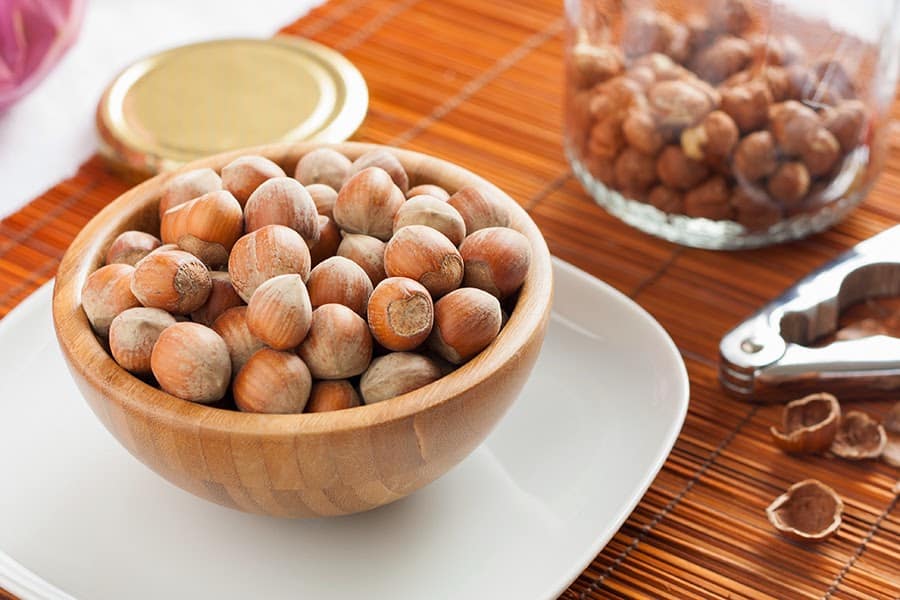
Hazelnuts and shelled nuts are often told in two opposite ways: either “miraculous” or “too caloric”. The useful reality is in the middle. This article is informative: it does not replace medical indications, but helps to consume in a more balanced way and avoid the most common mistakes, those that ruin quality or confuse ideas. The point that is almost always missing online is that health and consumption depend not only on “what”, but also on “how” and “how stable” what you are eating is. For this reason we keep together three planes that in real life are inseparable: daily consumption, product stability, sensory quality.
A simple rule for daily consumption
Italian guidelines, when they talk about shelled nuts, do not invite to chase perfect numbers: they invite to stay on a practical criterion. Small quantities, controlled quantities, and attention to the choice of product. In particular, the recommendation is to prefer “natural” products, because salting and glazing really change the food you are introducing. This is a good basis both for those who buy for home and for those who select ingredients for a laboratory: if you want to understand how a food makes you feel, the first thing is to reduce the “extras” and stay on the simplest possible product. From here comes a first myth to be dispelled: “hazelnuts” are not always the same thing. Natural hazelnut and “dressed” hazelnut (salt, sugars, aromas) are different experiences and have different weights in a diet. The advice is not moralistic, it is operational: the simpler the product, the more readable the consumption.
Product stability: the quality that is seen after, not immediately
Shelled nuts have a profile that makes them very interesting, but also sensitive over time. The technical literature says it clearly: the lipid fraction of shelled nuts is composed of unsaturated fatty acids and can easily go rancid. When it happens, it is not only a “taste” defect: it is a real change in quality and consumption experience. If you want to translate it at home, and without technicalities, just remember what are the factors that push in the wrong direction: oxygen, temperature, humidity and exposure to light are indicated as main factors in lipid alterations. This is why domestic storage is not a marginal note. It is part of quality. From here comes a practical consequence, also valid for those who sell: if the product remains long exposed to air and light, or in a hot and humid point, you are accelerating exactly the factors that matter most. Storing well means protecting the “good” part over time, not just the taste of the first taste. A concrete way to almost never go wrong is to look at the kitchen with different eyes: not “where it fits”, but “where it is more protected”. If in a point there are direct light and heat, it is a hostile point for stability. Typical mistakes that seem small, but weigh:
- choosing salted or glazed products “because they are hazelnuts anyway”
- leaving shelled nuts exposed to air after opening
- keeping them in a hot point or in direct light
- ignoring anomalous smells thinking they are “a different roasting”
- believing that heat makes the hazelnut “safer” for those who are sensitive
Sensory quality: the most honest filter, before theory
Sensory quality is the most concrete part, and often the most neglected. Here the reference of Romana Hazelnut is useful because it uses simple words, from consumer, but written as quality requirement: must be absent any taste of rancid oil, mold and herbaceous. It is a compass that also works outside the DOP. This does not require training: it requires honesty. If you feel rancid, mold or a marked herbaceous tone, you are not “just choosing a taste”. You are encountering signals that, in a regulation, are explicitly excluded. For those who buy for work, here is a very clean commercial point: sensory quality is not a whim, it is part of value. And storage stability is “quality” as much as aroma, because it determines how long that value remains true.
Allergies: no shortcuts, especially with roasting
On allergies, the internet is full of wrong shortcuts. One of the most widespread is the idea that roasting “solves”. In institutional documents on the topic there is a clear indication: allergens of shelled nuts are stable proteins not denatured by the thermal treatments to which these fruits are commonly subjected. This phrase alone is enough to put ideas in order: roasted does not mean “neutral” on the allergenic level. In the presence of sensitivity, the reference remains always sanitary. Useful internal link, if you want to deepen the “nutrition and heart” part without duplicating here: