
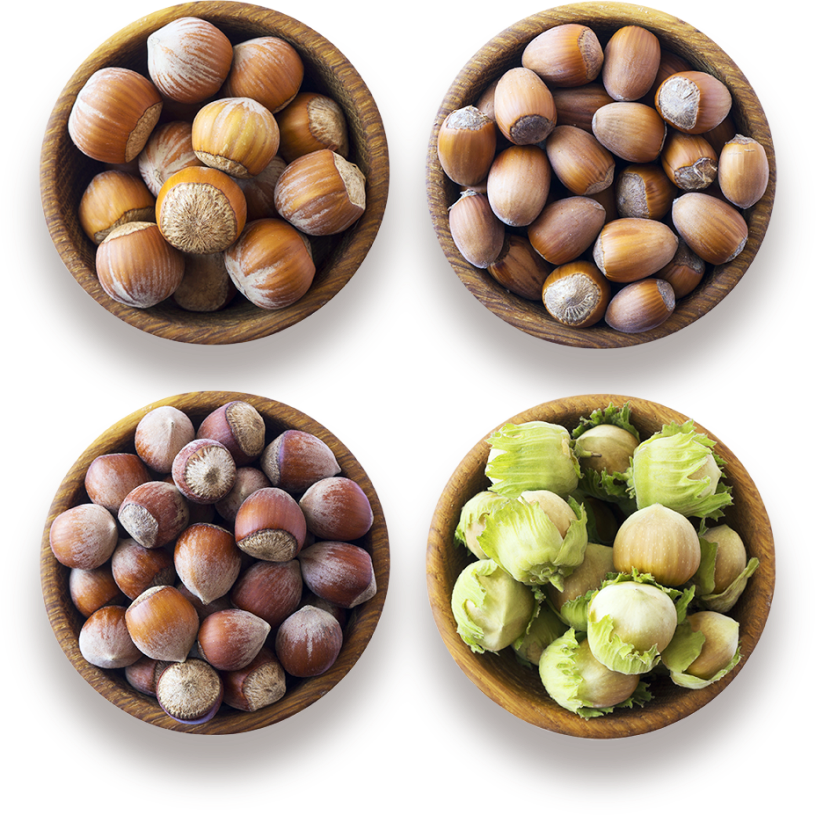
A “well-written” specification often fails on one detail: the hazelnut name. That’s where misunderstandings, disputes about what was delivered, and sterile arguments between “what I meant” and “what you understood” tend to start. The reason is simple: in everyday language, names get shortened. In B2B documents, names must remove ambiguity—not create it.
Before the name: the species
If your scope is the “standard” hazelnut for the food industry, the botanical reference is Corylus avellana. Putting it in the specification is not pedantry: it is a quick way to state which plant you are talking about, and to separate technical discussion (varieties, defects, processing) from noise.
Protected names and cultivars are not the same thing
This is where most confusion happens: one thing is the protected/commercial name (how it appears on labels or documents), another thing is the cultivar.
Practical example: in the specification of the IGP “Nocciola del Piemonte” / “Nocciola Piemonte”, the name is linked to the variety “Tonda Gentile Trilobata”. That means that, if in an order you write only “Tonda Gentile” or only “Piemonte”, you are leaving room for interpretation.
Likewise, “Nocciola di Giffoni” is not a generic way to say “a hazelnut from Campania”: in the specification it is linked to the fruits of the biotype corresponding to the cultivar “Tonda di Giffoni”.
For “Nocciola Romana”, the DOP defines the scope on specific cultivars: “Tonda Gentile Romana” and “Nocchione”. Here the word “Romana” is particularly tricky because it can be used as a commercial shortcut, but in a specification you need the full form.
Why “Tonda Gentile” is a trap
In spoken language, “Tonda Gentile” may sound sufficient. On paper, it is not. Within the official specifications, there are multiple “Tonde Gentili” with different qualifiers: “Trilobata” on one side, “Romana” on the other. If you do not specify, you are asking the supplier to guess what you mean. When the name is short, your spec becomes a bet—and in B2B purchasing, you almost always pay for that bet later.
How to write a specification that cannot be misread
The goal is that, reading one line of specification, two different people reach the same interpretation. A simple “field-based” schema works well—no long sentences and no synonyms.
- Species: Corylus avellana.
- Requested protected name (if applicable): written in full and consistent (IGP or DOP, no creative abbreviations).
- Declared cultivar: spelled out (e.g., Tonda Gentile Trilobata; Tonda di Giffoni; Tonda Gentile Romana; Nocchione).
- Product form and state: in-shell or shelled; raw or roasted; blanched if required.
- Acceptance criteria: excluded defects, excluded off-odors, batch cleanliness, agreed documentation requirements.
Note: the last field does not “make quality” by itself, but it turns quality into verifiable terms. If it is missing, even a perfect name can still turn into an argument.
Quick questions that prevent weeks of friction
When you receive an offer or a technical sheet, three questions clarify almost everything:
- Is the name you are using a protected name (IGP/DOP) or a variety?
- Is the cultivar explicitly stated, or just implied?
- Is the product form the one you need today, or the one the supplier has available?
If an answer remains “generic”, the problem is not the answer: it is the specification line that must be rewritten.