
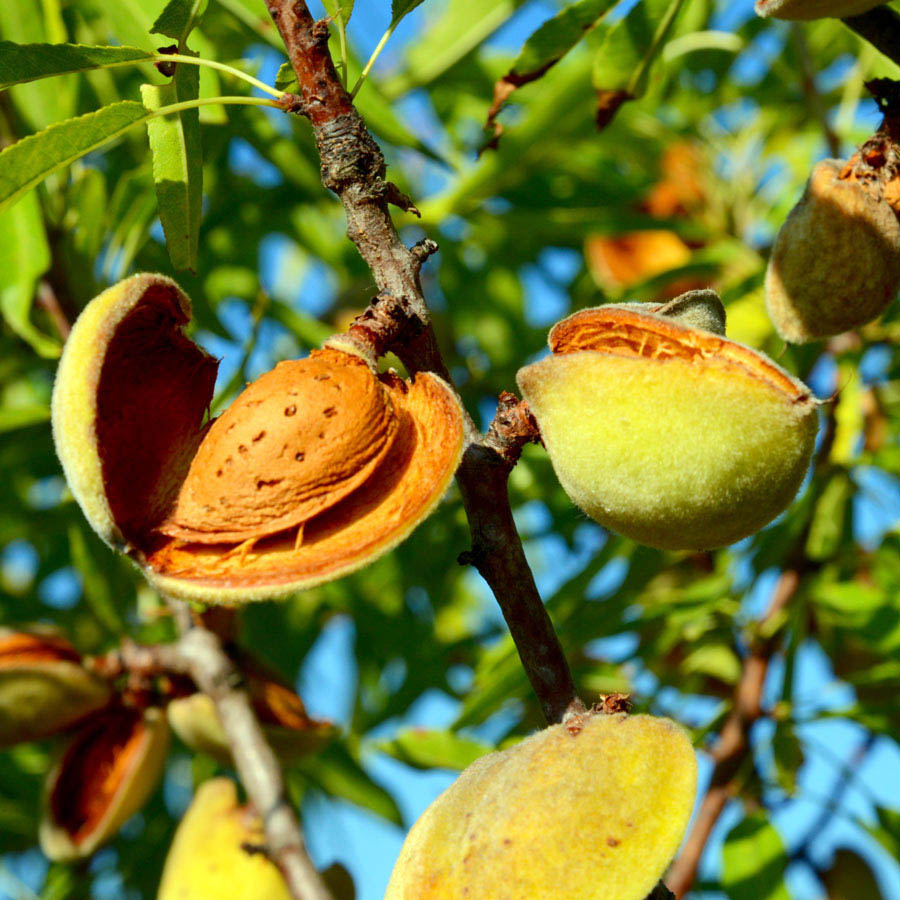
The price of almonds is not a fixed number. It’s a synthesis that changes with the harvest year, with real availability, with demand, with the type of product the market is “pulling” at that moment, and with what you’re really buying: in-shell, shelled, peeled, more or less selected.
The useful part, for a buyer and also for an attentive consumer, is to separate the question “how much does it cost per kg” from a more concrete question: “how much does it cost me to obtain almonds that work for my use”.
This distinction makes sense because price, by definition, forms in the meeting between demand and supply. Then, in practice, that figure transforms into experience and result: in a snack that remains clean until the last bag, or in an ingredient that holds processing without carrying defects and variability.
A context worth keeping in the background is that demand for tree nuts is indicated as increasing, and in the last ten years apparent consumption in Italy has grown by 25%. In the same picture, for almonds (Ismea table, million kg) appear production 78, imports 134, supply degree 41%, apparent consumption 189. This type of picture doesn’t tell you “how much you’ll pay tomorrow”, but it explains why prices don’t read well if treated as a stable and local tag.
Here enters the key that aligns this reasoning with the B2B world, without excluding those who buy for home: distinguishing between nominal price and real cost.
- Nominal price: the quotation, the number in the first row.
- Waste: what you lose if the lot is not consistent with use (uniformity, defects, breakage, cleanliness).
- Quality risk: variability between bags and durability over time (sensory stability, predictability).
When you optimize only the nominal price, you’re often just shifting the cost to the other two rows. And that’s where disputes, disappointments and “almonds that don’t perform” are born, even if on paper they were convenient.
So far the concept. Now the operational part: what variables really move the price proposed to you, and how to avoid false comparisons.
Harvest year and yield: what really changes in practice The phrase “harvest year and yield influence available quantity and quality” is true in a practical way: perceived availability changes and the average quality the market expects to find changes. The result is that the same word, “almond”, can include lots with different stories and, therefore, different prices even for the same commodity category.
Availability per lot: the market is not an average Many reason as if there were a single price “for almonds”. In reality, there often exists a price for a specific lot with a specific specification. When availability is fragmented, windows and volumes matter: not because they are “logistics” in the abstract sense, but because they determine what is really purchasable at that moment, with what continuity and with what level of selection.
Selection and conditioning: you pay for control or you pay for waste Selection and conditioning can increase the nominal price, but reduce the real cost if they lower your waste and quality risk. This is the most underestimated point by those accustomed to comparing offers only by figure: two quotes are not comparable if one includes a level of control that the other doesn’t include, even if both write “shelled almonds”.
Format and final use: the “universal” almond doesn’t exist Snack, ingredient, processing are three different ways of measuring the same batch. In the first, sensory cleanliness and consistency matter most. In the second, uniformity and predictable behavior matter. In the third, yield, aromatic notes and sensitivity to defects emerge that might pass in direct consumption.
If you produce Tuono, here’s an important point: avoid automatic comparisons with generic items. Not because “Tuono is better by definition”, but because a cultivar, an origin and a specification are not interchangeable with a standard item. Price only makes sense if you compare truly comparable products.
Price list examples: a spy of the trend, not an absolute truth The objection you made is correct: clean and public historical series don’t always exist for an Italian specification (like your Tuono) on a chamber basis, in the same way that some recurring items are found for hazelnuts.
What often exists instead is a “thermometer item” repeated over time, useful only to see that the number moves. In the Florence Chamber of Commerce price lists, “shelled california almonds” recurs. Three photographs, in different years, show a non-linear trend:
In price list n. 16 the item is from 10.00 to 12.00. In price list n. 22 the same item is 7.00 and 7.00. In price list n. 35 it returns to 9.10 and 9.20.
What to do with them, concretely, without forcing the data:
- use them as a spy of variability, not as “right price”;
- remember that these items say little about a well-specified Tuono, but say a lot about how much the specification matters in the comparison.
Comparable quotes without wasting time It’s not necessary to transform purchasing into a bureaucratic procedure. It’s necessary to remove ambiguity. A quotation request becomes useful when it clearly communicates four pieces of information: quantity, destination, format and final use. Then, if you want to talk about real cost, you need to add what you mean by “useful quality”: selection requirements and defect tolerances, even just in practical terms.
This doesn’t automatically “lower” the price. It allows you to understand why two offers are different and, above all, to avoid the classic mistake: optimizing the number in the first row and discovering later that the lot doesn’t hold up to use.
Suggested links To deepen quality controls and signals to monitor: Quality and defects: what to check in an almond batch
For post-purchase management and storage: Almond storage: how to protect aroma and shelf-life