
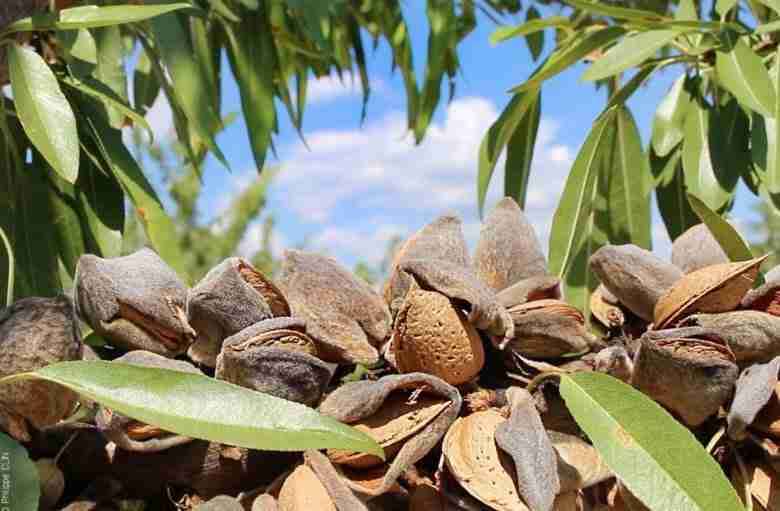
Almond seasonality is not just “when they’re harvested.” It’s especially the journey that transforms a freshly picked fruit into a stable, readable, comparable product. For those who buy or process, this transition is the difference between apparent availability and real availability. For those buying from private sources, it’s why two almonds “from the same year” can behave differently in the pantry.
The real season begins when the hull opens
In the Campania Region discipline, maturity is identified with hull dehiscence, starting in the second decade of August and ending in the third decade, tied to the earliness or lateness of the cultivar. The practical point, often overlooked, is the indicator: we look at when hulls begin to open in the innermost and shaded parts of the canopy. This detail explains why “the same tree” is never all ready at the same instant, and why harvest is more a window than a date.
If you produce, the window forces choices: how to manage harvest to avoid chasing maturity with endless passes; how to avoid the product staying too long in a gray area where it’s no longer “in the field” but not yet “stable.” If you buy, that window tells you something simple: talking about “seasonal” almonds without asking what stage post-harvest processing has reached means talking only about calendar, not availability.
We, working with Tuono almond in Viterbo (Lazio), often see the same misunderstanding: people think harvest and availability coincide. In reality, between the two lies the phase that determines stability and repeatability.
From fruit to batch: when the almond becomes plannable
After harvest, almonds don’t “preserve themselves.” The technical sequence matters. In the Campania discipline, a clear step is described: fruits are freed from the hull with hullers, then dried to a water content in seeds and shells around 8-10%. Only after can the supply chain choose subsequent processing like shelling, blanching, and sizing.
This sequence, read operationally, means the product changes identity multiple times:
- as long as it’s “with hull,” it’s not yet the almond the market means when talking about “in-shell”;
- as long as it’s not dried to a level compatible with preservation, it’s not a batch you can treat as stable;
- as long as it hasn’t been processed (if planned), it’s not yet the format you really need.
In a supply chain technical sheet, a traditional practice of detachment via pole beating is also described, followed by air drying in the order of 28-48 hours. It’s a useful detail not because it “applies everywhere,” but because it makes visible the concept: before industrial processing, there’s a minimum technical time where the product is stabilized and prepared for subsequent steps.
Why post-harvest and storage matter more than admitted
The point isn’t to create alarm, but to read reality: in the Ministry’s sector plan, it’s specified that, in different post-harvest phases, nut species can suffer losses even from fungal pathogens. Translated into buyer and processor language: the “unseen” phase is often the one that decides defects, disputes, and stability.
Here arises a simple criterion for planning without being dragged by moment urgency: don’t reason only about “when almonds arrive,” but about “what technical state they arrive in.” It’s an approach that also works for consumers: an almond can be new to the year, but not necessarily well stabilized or managed.
The batch is the real planning unit, not the bag
When discussing programming, we often end up discussing formats and quantities. In reality, the first useful question is: what is the batch. The Turin Chamber of Commerce guide explains it clearly: for traceability, the minimum unit is not the single package, but the production batch, and a batch can be destined for multiple customers. This changes the way it makes sense to “plan.”
The batch, for B2B buyers, is a verifiable promise: consistency, repeatability, ability to reconstruct what happened if a problem emerges. For those selling retail, it’s a transparency opportunity: it’s the simplest way to avoid the classic “different every time.”
Four questions worth more than a calendar
If you want to make seasonality useful (not just narrative), try shifting the conversation to these four operational questions, valid for both professional purchases and those who want to buy well:
- In which maturity and harvest window is the product placed (hull dehiscence as practical reference)?
- Has the fruit already been shelled and brought to a drying condition compatible with preservation (around 8-10%)?
- What processing has already been done, and what’s planned (in-shell, shelled, blanched, sized)?
- Which batch does it belong to, and how is batch-level traceability managed?
These aren’t “quotation” questions. They’re quality and planning questions. They tell you if you’re talking about ready-to-use almonds, or raw material that still needs to become them.
Useful internal guide links
Quality and defects in almonds: how to really read a batch (beyond “good/bad”)
Almond storage: how to protect aroma and shelf-life