
February 17, 2026 | by Le Due Querce editorial team
Italian hazelnut production is extremely concentrated: three regions alone represent 81% of the national area cultivated with hazelnuts. But behind this figure lie three very different production stories, three cultivars with distinct organoleptic characteristics, and three supply chain models that respond to different market logics.
Understanding these differences is essential both for those who produce and want to position their harvest, and for those who buy and must correctly interpret an offer or quotation.
The numbers: how much and where it’s produced
According to data from the National Hazelnut Plan 2022-2025, in 2021 Italy had 92,310 total hectares planted with hazelnuts, of which about 84,500 hectares were in production. The area has increased by 29% in the last ten years (from 71,520 hectares in 2015 to 92,310 in 2021), making hazelnuts the fruit species with the greatest investment increase in Italy in the considered period.
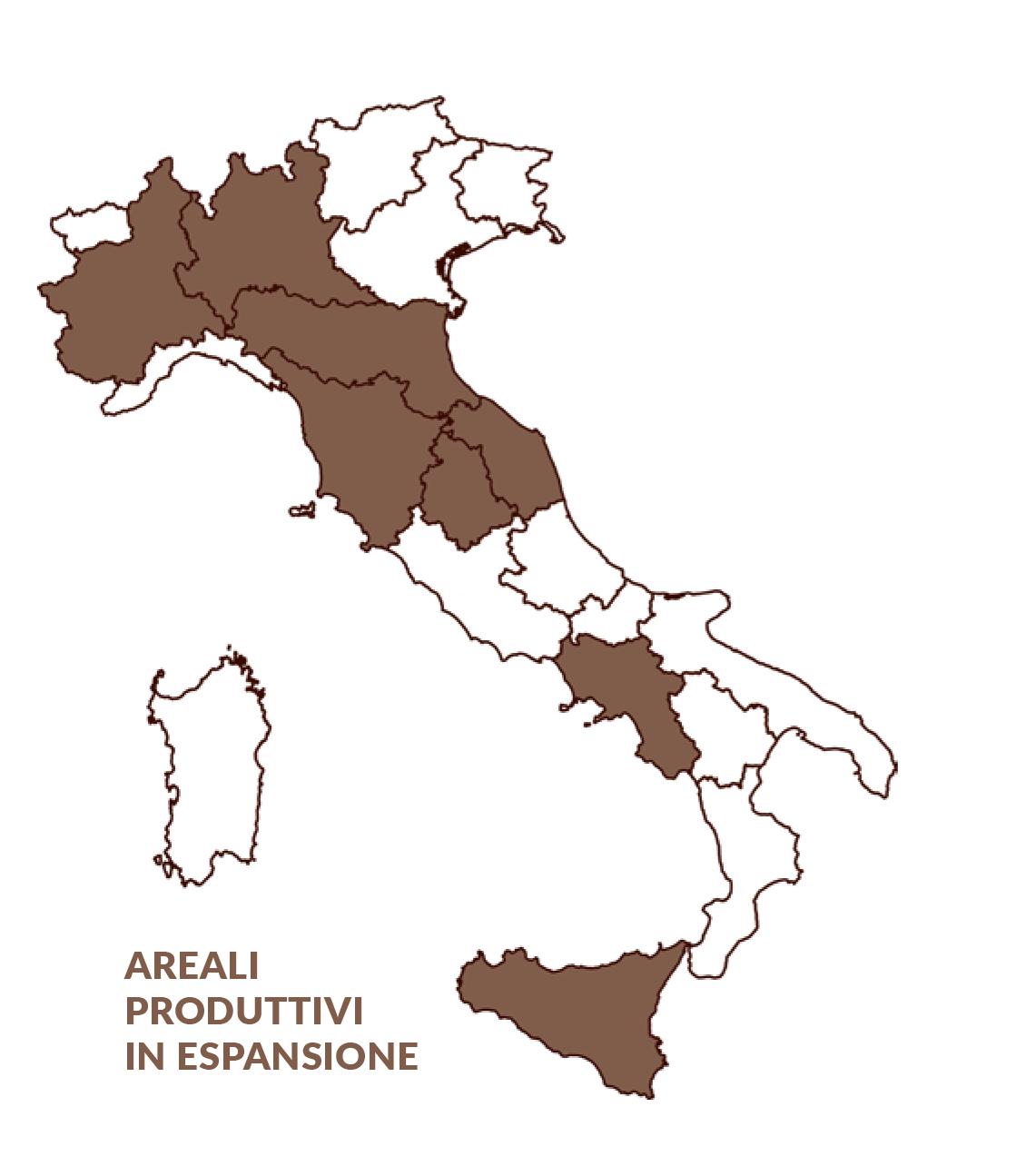
The regional distribution confirms a very strong concentration:
- Piedmont: 29% of the national area (about 26,700 hectares)
- Lazio: 27-28% of the national area (about 25,000 hectares)
- Campania: 24-25% of the national area (about 22,000 hectares)
- Sicily: 11% of the national area (about 10,000 hectares)
At the provincial level, the concentration is even more marked: the first four provinces alone cover two-thirds of the national area. Viterbo is the leading province with 26% of the Italian area (about 24,000 hectares), followed by Cuneo (18%, about 16,500 hectares), Messina (14%, about 13,000 hectares) and Avellino (9%, about 8,300 hectares).
The average national production in the period 2016-2021 was about 118,000 tons per year of in-shell product, with significant oscillations between seasons due to bearing alternation and climatic variability. In 2020 a peak of 140,000 tons was reached, while in 2023 and 2024 production fell below 90,000 tons due to frosts, drought and phytosanitary pressure.
Piedmont: premium quality and strong aggregation
Piedmont hazelnut cultivation is concentrated mainly in the provinces of Cuneo (over 16,000 hectares), Asti (about 3,500 hectares) and Alessandria (about 3,000 hectares), in the Langhe and Roero area. The dominant cultivar is Tonda Gentile delle Langhe, also known as Tonda Gentile Trilobata, which represents over 90% of the plantings.
Piedmont is the region that recorded the greatest area increase in the last ten years: +62% compared to the 2010-2015 period. This boom was favored by investments from large processors (especially Ferrero, based in Alba), the availability of well-exposed hillside terrain, and the strong reputation of Tonda Gentile delle Langhe on the international market.
The distinctive feature of the Piedmont model is the high degree of aggregation. Hazelnut Piedmont IGP, recognized since 1993, has a very active protection consortium and a highly integrated supply chain. Piedmont Producer Organizations (POs) move significant volumes and have established commercial relationships with large processors. This allows Piedmont producers to obtain stable prices and multi-year contracts, albeit with reduced bargaining power compared to processors.
From an agronomic point of view, Tonda Gentile delle Langhe has a medium-high shelling yield (45-48%), medium caliber (13-15 mm) and highly appreciated organoleptic characteristics: intense but balanced aroma, high crunchiness, low percentage of voids. It is the reference hazelnut for the Italian and international confectionery industry.
Lazio: high yield and recent expansion
Lazio production is concentrated almost entirely in the province of Viterbo, particularly in the municipalities of Upper Lazio around the Cimini and Sabatini mountains. The main cultivar is Tonda Gentile Romana, accompanied by Nocchione. Overall, these two cultivars represent over 85% of Lazio plantings.
Lazio has seen steady growth in the last fifteen years, with a 13% increase in area and 8% in harvested production in the period 2016-2021 compared to 2010-2015. This growth was supported by new plantings financed also by extra-agricultural investors attracted by the profitability of the crop, especially in a context of high hazelnut prices in the period 2017-2022.
The distinctive feature of Lazio is the highest yield per hectare in Italy. ISMEA and ISTAT data show that, for equal area, Lazio produces more than Piedmont and Campania. This is due to several factors: very fertile volcanic origin soils, favorable climate with mild winters and hot but not torrid summers, water availability (many plantings are irrigated) and, last but not least, the fact that a good part of Lazio plantings is relatively young, planted in the last 10-15 years with selected cultivars and modern planting layouts.
Nocciola Romana DOP, recognized in 2009, covers 37 municipalities between the provinces of Viterbo and Rome. The regulations were recently modified to increase supply chain resilience: the minimum threshold of characterizing cultivars (Tonda Gentile Romana and Nocchione) dropped from 90% to 80%, allowing integration of native varieties such as Barrettona, Casamale and Rosa.
From a commercial point of view, Lazio has a lower degree of aggregation than Piedmont. The supply chain is more fragmented, with many small-medium producers who sell directly to local processors or collectors. However, there are some active Producer Organizations (6 POs specialized in hazelnuts in Lazio according to the Hazelnut Plan), which are working to consolidate the offer and improve producers’ bargaining power.
Tonda Gentile Romana has slightly different organoleptic characteristics from Tonda delle Langhe: more spherical shape, slightly smaller caliber (12-14 mm), fine but less intense flavor, high crunchiness. It is highly appreciated for pelability (ease of removing the skin after roasting) and for kernel compactness (low incidence of internal voids).
Campania: secular tradition and fragmentation
Campania was historically the first hazelnut-producing region in Italy and still maintains significant areas today, concentrated mainly in the provinces of Avellino (Giffoni Vallepiana and Monti Picentini area) and Naples (Alto Casertano, bordering Lazio and Molise). The dominant cultivar is Tonda di Giffoni, which covers over 80% of Campania plantings.
Unlike Piedmont and Lazio, Campania has seen a reduction in both area and production in the last fifteen years. The number of hazelnut companies fell by 49% between 2010 and 2020, dropping from 11,565 companies to 5,902 companies. This decline is due to several factors: advanced age of operators, excessive fragmentation (average farm size is less than 2 hectares), difficulty of mechanization on often steeply sloping terrain, and low profitability for small areas.
Tonda di Giffoni IGP, recognized in 1997, is one of the oldest and most appreciated hazelnuts in Italy. It has a medium-large caliber (14-17 mm), rounded shape, good shelling yield (46-50%) and very distinctive organoleptic characteristics: persistent aroma, marked sweetness, fine texture. It is particularly appreciated in the artisanal pastry sector and for processing into hazelnut paste.
The Campania production model is the most traditional and fragmented of the three. Most companies are small, often run part-time or by elderly farmers. Aggregation is weak: there are 3 POs specialized in hazelnuts in Campania, but they move reduced volumes compared to potential. This makes negotiation with processors difficult and causes prices to be more volatile than in Piedmont and Lazio.
In recent years, especially in Alto Casertano, there has been a partial renewal: new modern, irrigated plantings on flat or moderately sloping surfaces, managed by young entrepreneurs. These new realities are trying to replicate the Lazio model (high yield, full mechanization, direct sales to medium-large processors), but the path is still in its early stages.
What it means for producers and buyers
For a producer, understanding the regional context in which they operate means understanding what the reference benchmarks are, what margins for improvement exist, and how to position their product. A Lazio producer with a yield of 2 tons/hectare is at the regional average, while a Piedmont producer with the same yield is below average. A Campania producer who manages to exceed 2.5 tons/hectare is in an excellent position, because the Campania average is lower due to old plantings and difficult terrain.
For a buyer, knowing which region a hazelnut batch comes from provides useful but insufficient information. The region indicates the dominant cultivar and general production context, but says nothing about the specific quality of the batch, its storage or traceability. A well-preserved Tonda Gentile Romana, with documented vintage and batch, is worth much more than a generic Tonda Gentile delle Langhe without traceability.
In summary, Piedmont, Lazio and Campania are not just three geographical names: they are three production models, three cultivars with distinct organoleptic profiles, and three supply chains with different market logics. Knowing these differences is the first step to correctly read an offer, evaluate a quotation or strategically position your harvest.
To understand the global context in which these regional dynamics fit, read World hazelnut production: geography, volumes and what really drives prices.
To orient yourself among different commercial names and protected designations, consult Hazelnuts: disambiguation of names for orders and specifications (Piedmont, Giffoni, Romana).
To understand how the international production crisis is creating opportunities for Italian producers, see Turkey hazelnut production collapse 2025: prices doubled and new opportunities for Italy.