
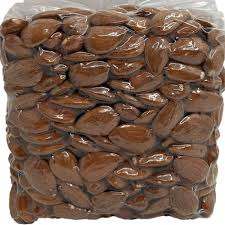
Storing Tuono almonds well comes down to a few key factors: kernel moisture, warehouse relative humidity (rH), temperature, the packaging barrier, and strict lot discipline. If these parameters stay stable, quality (crunch and aroma profile) holds for much longer and the risk of moulds and aflatoxins is reduced in a tangible way.
What is the ideal moisture level (in-shell vs shelled almonds) to prevent mould and quality loss?
The most widely used technical target for quality and stability is kernel moisture around 3–5%. It’s the “sweet spot” because it helps preserve crunch and limits storage issues. As an operational target across the supply chain, many aim to stay below 6% to reduce risk during storage, transport, and distribution. This is
The environmental threshold to remember is simple: above ~65% rH the risk of mould growth starting increases. In general, within a 20–65% rH range, almonds tend to stabilise at a moisture content of ~3–6%, which is a “safer” range for limiting unwanted reactions as well.
The difference between in-shell and shelled matters a lot:
- Shelled almonds (kernels): they are more sensitive to re-absorbing moisture and, from a quality standpoint, also to oxidation. If they take on moisture, they lose “snap” and become more vulnerable.
- In-shell almonds: the shell provides physical protection, but it is not a perfect vapour barrier. In industry practice you’ll find references to values around ~6% as a typical level or safety limit for some “soft-shell” types. When it comes to contaminants and controls, however, the reference remains the edible portion (the kernel).
For safety, moisture percentage is not the only KPI. More “food safety” oriented is water activity (a_w), because it describes how much water is actually available to microorganisms. A very common operational target is a_w < 0.70 (at 25°C), because below this level Aspergillus growth and aflatoxin production are inhibited.
A practical B2B example, “shelled Tuono lot for the confectionery industry”: an internal specification may require maximum moisture 5.5–6% and a target a_w 0.55–0.65 as the operating range. If the lot falls outside the range, typical actions are conditioning (ventilation/dehumidification) or segregation and, if necessary, rejection.
In day-to-day work, this is also central for anyone searching for “Storing Tuono almonds: storage, shelf life, moisture and aflatoxins” with an operational focus: moisture and a_w are the two numbers that prevent unpleasant surprises.
How to set up storage: temperature, ventilation, light, and choice of containers/pallets for Tuono lots
The most effective rule is to keep the warehouse cool and dry. As an operational reference, it’s common to use temperature below 10°C and rH below 65%. The reason is practical: less moisture migration, less lipid oxidation, less insect activity.
Ventilation is mainly needed to prevent humid “microclimates” inside the logistics unit:
- Big bags and sacks: if they are very compact or poorly positioned, they can trap moisture and create zones with higher rH.
- Bins: they help mechanical handling, but filling level, covers, and air exchange still matter.
- Wrapped pallets: they protect from dust and contact, but if the film blocks exchange and the internal air is humid, it creates an unfavourable microclimate. In these cases, area ventilation and rH management become decisive.
When ambient rH is high, dehumidifiers and well-managed air changes make the difference. If a lot has taken a mild “hit” of moisture, acting early with dry air can limit the damage.
Light is not a detail. In analytical procedures for aflatoxins, exposure to UV light is reduced for sample stability reasons. In a warehouse, this translates into a simple best practice: avoid direct sunlight and local overheating, typical of pallets near doors and windows.
For premium shelled Tuono almonds, material choice matters: to “block” moisture migration you need a vapour barrier, so PE liners, multi-layer sacks and, when needed, barrier films. The logic changes between domestic distribution and sea export, where times and conditions are more variable.
Pallet and lot management, from a B2B perspective:
- pallets on clean bases
- distance from walls and floor to reduce condensation and rising damp risks
- traceability by Tuono lot with arrival/shelling date, initial moisture, destination (blanching, roasting, industrial use)
- segregation of “at-risk” lots (borderline moisture/a_w or damaged packaging)
If upstream there is temporary pre-processing storage (stockpile), the critical point remains rH within the pile: rH above 65% is a limit not to exceed, paying attention to condensation and covers.
How long is the shelf life of Tuono almonds, and what signs indicate rancidity or loss of crunch?
Under recommended conditions (cool, dry, moisture under control) almonds can exceed 24 months. With high-protection packaging, for various forms (raw, roasted, blanched, sliced) there are also reported cases up to around 3 years.
The two main ways shelf life “ends” are different and need different levers:
- Loss of crunch: almost always a moisture-uptake issue (high rH, weak barrier, environmental fluctuations).
- Rancidity: lipid oxidation, driven by time, temperature, oxygen, light, and also the presence of metals. Stable conditions (no swings) help.
Signs to catch early, before the customer notices them in the finished product:
- a cardboard or paint-like smell
- bitter or sharp notes
- less “snap”, softer texture
- during roasting, potentially darker colour and defects that emerge as “concealed damage”
In QA, beyond sensory panels, analytical indicators are used: among volatiles, hexanal is a traditional marker for oxidation (with the note that other aldehydes and ketones can increase even earlier in some cases).
For industrial buyers, the definition of “end of shelf life” usually combines:
- sensory panel
- any oxidative indices (peroxides/anisidine) in the internal quality plan, with values to be defined by application
- moisture and a_w control to guarantee crunch in processes such as dragées, pralines, and chopped inclusions
Format changes everything: whole almonds last longer than broken pieces, flour, or paste, because the surface exposed to oxygen is greater. Roasted product can have a different profile: aromas may mask the start of rancidity, but oxidation can continue.
Here too, the key phrase “Storing Tuono almonds: storage, shelf life, moisture and aflatoxins” is useful: shelf life and quality risk are mainly controlled through moisture, rH, and oxygen.
Aflatoxins: when they form, which factors promote them in storage, and how to reduce risk in practice
Aflatoxins are produced by moulds of the genus Aspergillus. In practice, risk increases when moisture and condensation come into play. The strongest operational point is this: keeping a_w below 0.70 (at 25°C) helps inhibit growth and production.
In warehouses, the factors that raise risk are recurring:
- rH above 65%
- temperature swings with a “sweating” effect (condensation)
- pallets near doors, where humid air enters
- “warm” incoming loads that then cool down
- wet or damaged packaging
- greater vulnerability of shelled kernels to moisture damage
Practical measures that genuinely reduce risk:
- accept only lots below the moisture threshold for risk management (in practice <6% kernel is often used as an operational reference)
- segregate borderline lots
- continuously control rH and temperature
- use moisture-barrier packaging when needed
- hygiene and pest control, because damage and contamination increase the likelihood of problems
For those buying or exporting into the EU, it’s useful to be clear on the legal limits under Regulation (EU) 2023/915 for almonds (an Italy-based operator typically sells within the EU single market, where these limits apply):
- intended for consumption or as an ingredient: AFB1 8 µg/kg and total (B1+B2+G1+G2) 10 µg/kg
- intended for sorting or physical treatment: AFB1 12 µg/kg and total 15 µg/kg
On the “market pressure” side, analyses of RASFF notifications (2011–2021) indicate that in reports for nuts, mycotoxins most often involve aflatoxin as the dominant cause and, for almonds, there are years with peaks in notifications. In other words: the cost of non-compliance can be high, including holds and rejections.
Monitoring and controls: sampling, moisture/aw measurement, and lot management to prevent non-compliance
At intake, a robust B2B flow starts with the simplest checks and moves to the most critical:
- document check (COA, origin, declared treatments)
- visual inspection (wet/broken packaging, stains, abnormal odours)
- % moisture measurement with a rapid method (e.g., NIR) and confirmation with a reference method (oven) when needed
- a_w measurement following standardised principles, with reference to ISO 18787:2017
- decision: release, segregate, condition
For aflatoxins, the biggest source of errors is non-homogeneity. Mycotoxins can be distributed very unevenly, so multiple increments, correct homogenisation, and sample preparation according to EU criteria are required. During analytical steps, limiting exposure to UV light is also предусмотрено.
For in-shell almonds, remember the practical rule: in the EU, limits apply to the edible portion. In control, you can shell them or manage the sample with shell/kernel factors, depending on the procedure adopted.
Lot management must be “audit-ready”:
- FEFO logic (first expired first out) based on harvest/shelling date, initial moisture, storage conditions, and destination
- history of non-conformities and complaints
- useful KPIs: % lots out of moisture spec, rH deviations in the warehouse, complaints for rancidity or loss of crunch
In storage, the foundation is continuous environmental monitoring with temperature and rH data loggers. Lot checks should then be scheduled and intensified with a “trigger” logic: HVAC failure, humidity spikes, observed condensation, weather events, and flooding.
Most common mistakes (condensation, temperature swings, lot mixing, pests) and a practical prevention checklist
Condensation is the number one mistake because it creates, in just a few hours, a perfect microclimate for mould. It happens when goods enter colder or warmer than the warehouse: the dew point is reached, water forms on sacks and pallets, local rH exceeds 65%, and risk increases. The most effective countermeasures are acclimatisation, door management, and, if possible, an anteroom.
Temperature swings in non-climate-controlled areas make everything worse. In stockpiles or temporary storage, incorrect covers can increase oscillations and promote condensation. Industry practice aims to reduce fluctuations and control moisture within the pile.
Lot mixing is a “silent” mistake. Combining lots with different moisture can trigger internal migration, worsen roasting uniformity, and increase the chance that a non-compliant lot “contaminates” the aggregate. The practical rule is to segregate and only blend after clear QC criteria.
Pests and mechanical damage increase vulnerability. Broken kernels, pieces, and defects (mouldy, damaged) are more exposed and harder to manage for quality and compliance.
Operational checklist (10–15 points) for prevention:
- “cool” warehouse temperature and rH under control (target <65% rH)
- T/rH data loggers active and verified
- check for condensation at doors, cold walls, shaded areas
- acclimatise incoming loads when needed
- packaging intact, dry, with no abnormal odours
- pallets spaced from walls and raised off the floor
- adequate ventilation to prevent microclimates in big bags and wrapped pallets
- vapour-barrier packaging for shelled kernels and for long routes
- intake measurements of % moisture and a_w (ISO 18787:2017 as reference)
- segregation of borderline lots and corrective handling (conditioning or rejection)
- FEFO and full traceability for each Tuono lot
- periodic sensory inspections (crunch, rancid odours)
- documented pest control and regular inspections
- scheduled cleaning and dust/residue management
- instrument calibration and records ready for audit
If the goal is to reduce complaints and non-compliances, this checklist is worth more than any “trick”: it is the practical foundation of Storing Tuono almonds: storage, shelf life, moisture and aflatoxins.