
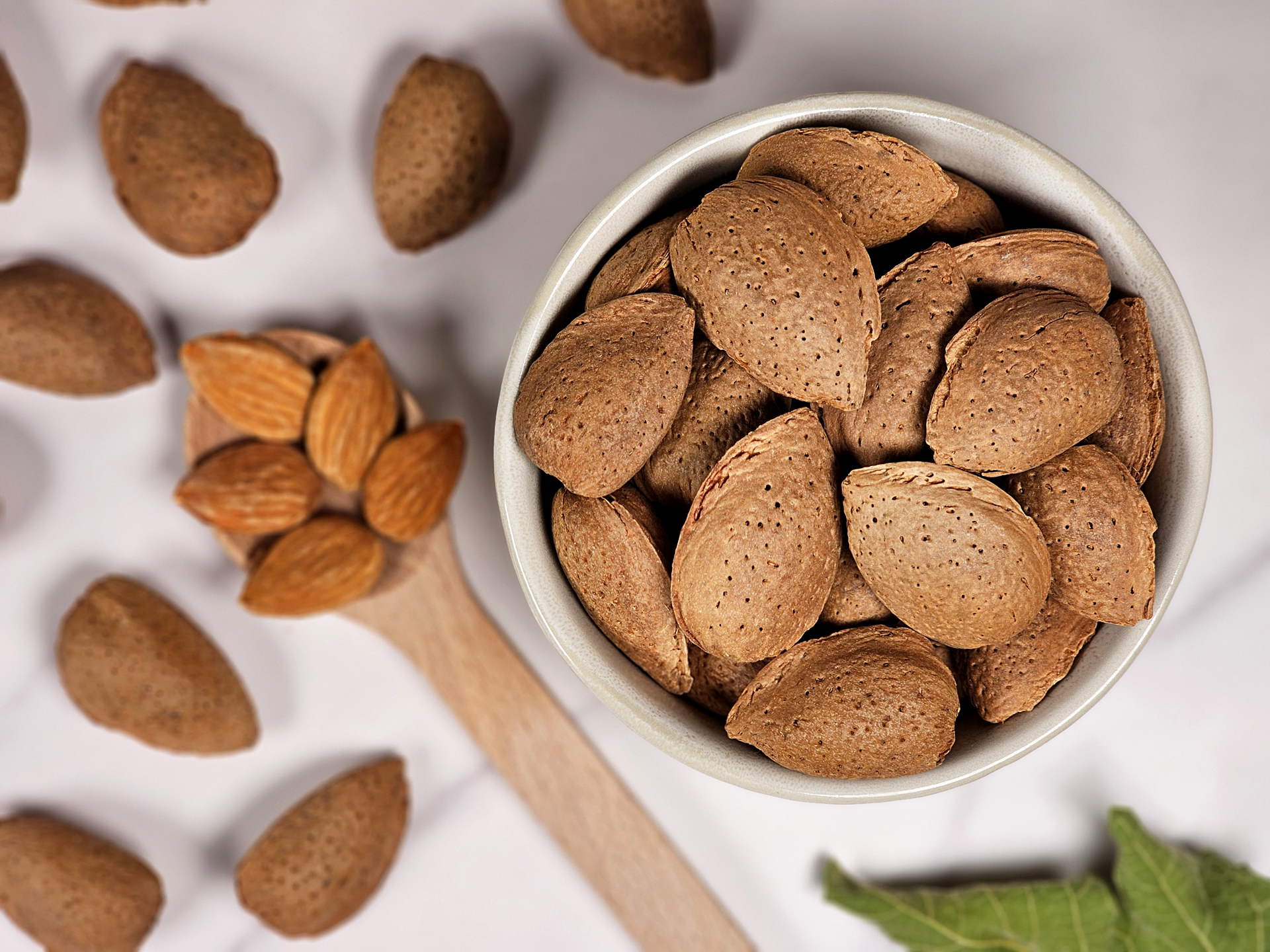
Storing almonds properly doesn’t mean “keeping them somewhere until needed”. It means deciding how the product should arrive at consumption or processing time: clean in smell, stable in taste, without stale notes and without surprises.
In practice, shelf-life is not just a date on the label. It’s the time during which aroma and quality remain consistent. And this consistency depends on few variables that deserve disciplined treatment, because they act silently.
The key point: almonds are rich in fats, and fats change. Technical literature on dried fruit reminds us that the lipid fraction, composed largely of unsaturated fatty acids, can undergo rancidity, producing unpleasant odors and flavors. When it happens, it doesn’t “get better”: it’s noticeable, and often definitively so. This is why the real work is preventing conditions that accelerate that change.
What accelerates aroma and stability loss Among the most relevant factors, the same ones always recur: oxygen, temperature, humidity and light. These are not abstract concepts. They are the four levers that, if out of control, make almonds age faster. And the effect becomes even more critical when the product is more “exposed”: shelled, broken, processed, because the same literature indicates that lipid alteration is particularly sensitive in these conditions.
This introduces a useful distinction even for home buyers: not all almonds “age” the same way, because not all face the same level of exposure. Format and physical state of the seed matter, because they change how vulnerable the product is to oxygen, humidity, light and temperature variations.
Before storage: drying is not a detail Storage is often discussed as if it were a separate chapter. In reality, conservation begins post-harvest, because part of the lot’s destiny is decided when the product is brought toward stability.
A technical document on almond trees reminds us that after hulling, almonds must be dried to reduce the amount of water present in shells and kernels. The logic is consistent with general technical guidelines for dried fruit: the purpose of drying is to bring humidity to near-optimal levels. Translated: if the product starts “unstabilized”, even a well-managed warehouse works uphill.
No need to turn everything into a theoretical exercise: just line up the practical consequences. If humidity is too high or unstable, risks of defects increase over time. If instead you start from a properly dried product, it becomes realistic to aim for more predictable sensory shelf-life.
Foreign odors: the risk that ruins without leaving visual traces There’s a typical mistake, especially when thinking in terms of “dry goods”: thinking that smell is just a matter of rancid or mold. Dried fruit is rich in fats and can absorb foreign volatile compounds, with negative impacts on odor and flavor. The environment doesn’t need to be “dirty” in an obvious way: it just needs to be aromatically invasive.
For this reason, technical literature is clear: storage must occur in clean warehouses free from foreign odors, away from potential contaminants like diesel fuel, sanitizers and detergents. This applies in B2B and also at small scale: almonds tend to carry with them what they “breathe” around, and then return it to the palate.
Mycotoxins: why prevention is not an empty word Anyone working with dried fruit knows there are issues that can’t be solved with “smell and understand”. In controls and alerts, dried fruit often appears among categories with irregularities, mainly for mycotoxins. This doesn’t mean every lot is a problem, but it means prevention is a real part of quality, not an extra.
In a blog that talks about quality, it makes sense to say it simply: sensory stability and correct product management are not just “pleasure”, they are also a way to reduce the probability of non-compliance throughout the commercial life of the lot.
A concrete strategy, without rituals Effective storage is not an endless list of rules. It’s a framework of choices consistent with the four levers (oxygen, temperature, humidity, light) and with odor risk.
A practical checklist, valid for both those managing a small warehouse and those storing at home, can be this:
- Protect the product from light, humidity, heat and “free” air: these are conditions that accelerate lipid alteration.
- If you need to store long-term, avoid anticipating processing that makes the product more sensitive (shelling, breakage, granulation).
- Dedicate clean spaces without foreign odors: olfactory absorption can ruin even a technically “healthy” lot.
- Start from a properly dried product: the goal of drying is to bring humidity toward optimal levels.
- Introduce simple periodic controls: open, smell, evaluate if the odor is still “almond-like” and has no deviations.
This is not an “industrial” or “domestic” method: it’s a realistic method. Those who sell or transform gain predictability. Those who consume get a more faithful and less disappointing taste.
Suggested links To deepen input controls and sensory signals to monitor: Quality and defects: what to check in an almond batch