
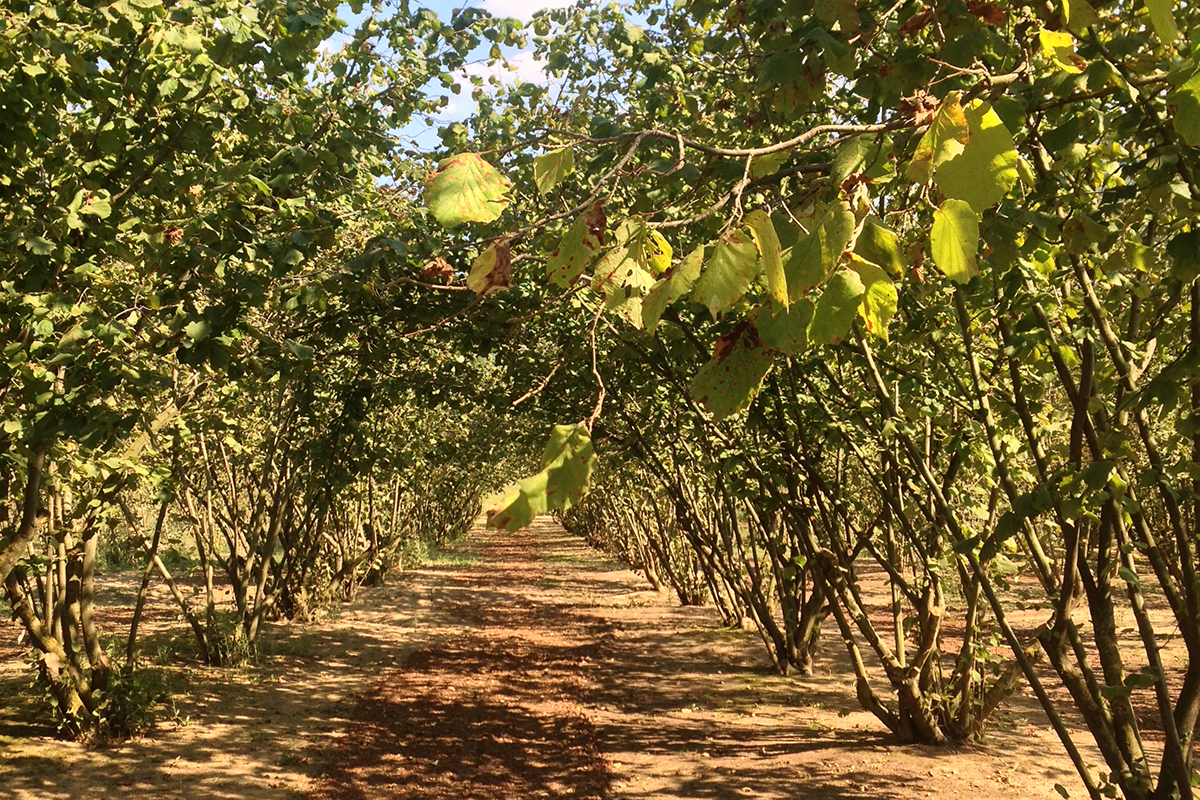
When we talk about climate change and hazelnut and almond production: impact on yields and seasonality, the point is not only “how much” is produced, but “how” consistency changes: more unstable flowering, less predictable harvest windows, and lots reaching the market with more variable timing and characteristics. In practice, for growers and buyers alike, the likelihood of “off-standard” seasons and less steady availability increases.
Below is a practical look at what is changing in terms of yield, quality, and the commercial calendar, sticking to established agronomic guidance and avoiding forced figures where outcomes depend too heavily on location and the specific year.
How does rising temperature affect flowering, fruit set, and yield in hazelnuts and almonds?
Rising temperatures mainly affect phenology (the plant’s biological calendar) and water stress.
- Earlier growth stages: in many areas, milder winters can bring forward budbreak and flowering. This may seem positive, but it increases exposure to possible cold snaps and makes the window for effective pollination “tighter.”
- More irregular flowering and pollination: hazelnut and almond rely on a delicate balance of temperature, humidity, and synchronization between male and female flowers (and, in almonds, also on pollinator activity). Abnormal temperatures can create mismatches and reduce fruit set.
- Heat stress and water shortage: with hotter summers and longer dry spells, the plant may “protect itself” by reducing growth and kernel filling. The typical result is greater size variability and, in difficult years, lower marketable yield.
- Indirect effects on plant health and physiological disorders: warmer and more humid conditions in certain periods, or intense heat followed by storms, can encourage health issues or physiological problems that affect quality and reject rates.
In short, climate change and hazelnut and almond production: impact on yields and seasonality often means more swings—not only from one year to the next, but even between nearby plots, depending on soil, exposure, and water management.
Which extreme events (late frosts, heatwaves, hail) weigh most on size grades, defects, and reject rates?
Extreme events matter because they strike at key moments and their effects are often “binary”: either damage occurs or it doesn’t. And when it does, it shows up in the parameters that buyers and processors care about.
- Late frosts: among the most critical when they arrive after a mild period that has advanced flowering or vegetative growth. They can reduce fruit set and crop load, and lead to uneven ripening. In almonds, sensitivity is particularly high if frost hits flowers or young fruitlets.
- Heatwaves: they affect kernel filling and quality. Generally, they increase the risk of:
- smaller or more variable size grades,
- less uniform kernels,
- a higher likelihood of stress-related defects (though the specific defect type depends heavily on variety and management).
- Hail and intense storms: beyond direct damage (wounds, drop), they can increase rejects due to cosmetic issues or poorer storability if the fruit enters post-harvest handling more vulnerable.
From a commercial standpoint, these events often translate into lots that are harder to standardize: more sorting, more grading, and closer attention to incoming defects and moisture.
How does seasonality change: when should we expect earlier or later harvests and commercial availability?
Seasonality does not change the same way everywhere, but the overall trend is toward greater variability.
- Earlier harvests: in hot years, some stages can speed up and lead to earlier harvest. This can also bring forward the arrival of the first lots, but it does not guarantee more volume: sometimes it’s earlier “because it ripens sooner,” other times “because the plant is stressed and ends the cycle earlier.”
- Delays and longer windows: paradoxically, the same year can cause delays in some areas or plots, especially with an unstable spring or events that interrupt development and make it uneven. Result: a more staggered harvest and less uniform lots.
- Less linear commercial availability: when harvest is more fragmented, drying, shelling, and sorting can also become bottlenecks. For buyers and processors, this means the availability “curve” can be less predictable.
This is where the key theme comes back: climate change and hazelnut and almond production: impact on yields and seasonality is not only an agronomic issue, but also a supply-chain planning issue.
Which Italian areas and varieties are more vulnerable (and which show greater resilience) under the new climate?
Without turning this into rigid rankings (because vulnerability depends on microclimate, soil, altitude, exposure, and management), some useful principles can be outlined:
- Areas with high late-frost risk: they are more vulnerable when mild winters advance phenology and then cold returns. Inland valleys and valley floors can be more exposed due to temperature inversions.
- Areas with hotter, drier summers: vulnerability increases where irrigation water is not available or soils have low water-holding capacity. In these contexts, resilience depends heavily on water management and, where applicable, variety/rootstock choice.
- Varieties and resilience: in general, the most “manageable” variety–area combinations are those that:
- have flowering less exposed to cold returns,
- better tolerate water and heat stress,
- maintain good uniformity even in irregular years.
Examples relevant to the Italian context (Italy is a major European producer with distinct growing districts by region):
- Nocciola Gentile Romana: in suitable Italian areas it can deliver high quality, but like all cultivars it can suffer in years with sharp swings in flowering and fruit set; agronomic management and site selection remain decisive.
- Mandorla Tuono: often chosen for agronomic traits that are useful across different settings; actual performance under climatic stress still needs to be assessed for each specific growing area and management approach (water, soil, pruning).
Which agronomic strategies reduce yield losses and stabilize quality year over year?
There is no single “cure,” but rather a set of practices that reduce sensitivity to extremes and improve consistency.
- Water management: where possible, targeted irrigation at critical stages (fruit set and kernel filling) and strategies to improve efficiency (monitoring, rational scheduling, loss reduction). Where irrigation is not available, conserving soil moisture becomes central.
- Soil and organic matter: practices that improve structure and water-holding capacity (managed ground cover, organic amendments where appropriate, reduced compaction) help buffer stress.
- Pruning aimed at balance: overly dense canopies can increase health issues and unevenness; overly open canopies can increase sunburn and stress exposure. The goal is to stabilize production and quality, not to chase peak yield alone.
- Protection and prevention: with “stranger” seasons, monitoring and timely interventions become more valuable, because some pests and diseases find unexpectedly favorable windows.
- Variety choice and orchard design: when renewing an orchard, key factors include:
- variety–area fit,
- pollination (compatibility and synchronization),
- spacing and canopy management for ventilation and light.
These levers do not eliminate risk, but they reduce the chance that a climate event turns into a commercial problem (out-of-spec size grades, higher rejects, uneven lots).
How can buyers and processors manage volatility in yields and seasonality (contracts, stocks, specs, and alternative origins)?
The key concept here is controlled flexibility: keep clear standards, but build in tools to manage irregular seasons.
- Contracts and planning: agreements that define delivery windows and quality criteria, with clear mechanisms to handle deviations (for example, on size grades or defect tolerances) without improvising mid-season.
- Stocks and lot planning: in highly variable years, having a stock strategy (even a minimal one) can help ensure production continuity.
- “Smart” technical specifications: distinguish between parameters that are truly critical for processing (moisture, defects that affect safety and industrial yield) and less decisive cosmetic parameters, to avoid excessive rejects when raw material is more variable.
- Alternative origins and blending: diversifying sourcing origins or growing areas can reduce the risk of being left short if an extreme event hits a specific zone. Lot blending, when technically appropriate, also helps stabilize profile and processing performance.
- Early communication along the chain: early updates on phenology and harvest outlook help avoid demand/supply spikes and support processing planning.
Ultimately, climate change and hazelnut and almond production: impact on yields and seasonality calls for a shift in approach: less reliance on “fixed calendars” and more risk management, from the field to the warehouse.